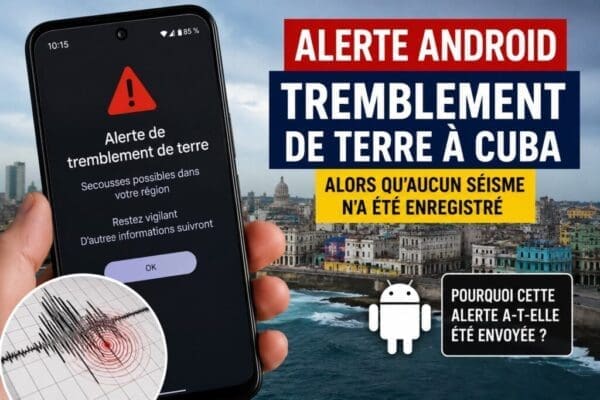
Illustration of the Android earthquake alert received in Cuba on August 18, 2026.
ANDROID ALERT · AUGUST 18, 2026
An earthquake alert sounded in Cuba… but no matching quake was confirmed
Android phones in Cuba displayed an earthquake warning on August 18, 2026. At the time of our verification, no matching earthquake had been confirmed and many people reported feeling no shaking.
What happened in Cuba on August 18?
On August 18, 2026, many people in Cuba received an earthquake alert on Android phones. The warning understandably caused concern, and some users waited for shaking that never came.
At the time Passion Varadero checked the situation, no earthquake matching the alert had been confirmed. That does not mean the phones deliberately “invented” a disaster. It is more useful to understand how Android’s earthquake detection system works and why a rapid automated warning can occasionally be sent before an event is confirmed by conventional seismic networks.
Android phones in Cuba did display an earthquake alert.
The alert alone does not prove that a significant earthquake occurred in Cuba.
Take the warning seriously, then verify the event with CENAIS and recognized seismic networks.
Where did the Android alert come from?
The warning may have been generated by Google’s Android Earthquake Alerts System, which is available in Cuba.
The system can use accelerometers in large numbers of Android phones as a distributed network of small sensors. When enough devices in an area detect movement consistent with the first waves of an earthquake, the system can estimate that an event is underway and rapidly warn people who may be in the affected area.
The goal is speed. During a real earthquake, that can sometimes provide several useful seconds before stronger shaking arrives. Google also makes clear, however, that not every earthquake can be detected and that early estimates of magnitude or shaking intensity may contain errors.
Why can an alert arrive without a confirmed earthquake?
Because this is a real-time automated detection system, not the same thing as an official final seismic confirmation.
Early data must be interpreted very quickly, often before conventional seismic networks have finished locating and characterizing an event. A preliminary detection can therefore be revised, downgraded or fail to correspond to a significant earthquake later confirmed by seismologists.
That appears to explain what happened in Cuba on August 18: the warning was received on many phones, but many people did not feel the expected shaking and no matching earthquake had been confirmed when we checked.
Does Google predict earthquakes?
No. Android Earthquake Alerts does not predict that an earthquake will happen hours or days in advance. It attempts to detect an event that appears to have already started and distribute a warning as quickly as possible.
Earthquake waves travel at different speeds. In some situations, an automated network can detect the first waves and send an alert before stronger shaking reaches people farther from the epicentre.
That is why speed matters so much. The same speed that can provide valuable warning time also means the earliest estimates are not always perfect.
What should you do if your phone shows another alert?
Do not ignore a future earthquake warning simply because the August 18 alert was not followed by shaking that matched the message.
- Move away from windows and objects that could fall.
- Protect your head and take cover if necessary.
- Avoid elevators during shaking.
- After the immediate warning, check information from Cuba’s National Center for Seismological Research (CENAIS) and recognized seismic networks.
- Do not immediately share a preliminary magnitude or epicentre as confirmed fact.
Should you disable Android earthquake alerts?
No, that is not recommended. Real earthquakes do occur in and around Cuba, particularly in the eastern part of the island. A future alert could correspond to a genuine event.
The safest approach is to separate two steps: react to the warning first to protect yourself, then verify the event using reliable seismic information. An imperfect alert does not make the system useless when a real earthquake occurs.
Frequently asked questions
Was the earthquake alert in Cuba fake?
The message on the phones was real. What was not confirmed at the time of our verification was a corresponding earthquake. An automated alert and an official seismic confirmation are not the same thing.
Does Android Earthquake Alerts work in Cuba?
Yes. Google lists Cuba among the countries where the Android Earthquake Alerts System is available.
Can I receive an alert without feeling shaking?
Yes. Google states that users may sometimes receive an alert without feeling an earthquake and that estimates can contain errors.
Where can I verify an earthquake in Cuba?
CENAIS and Cuba’s national seismological service are the main local references for confirming seismic activity on the island.
Useful guides
Current Cuba information and practical travel guides in English.Is Cuba safe for travellers?
Practical precautions for current conditions in Cuba.
Verified sources
- Google Android — Earthquake Alerts System
- Granma — Android earthquake alert system and availability in Cuba, June 29, 2026
- CENAIS — Cuba’s National Center for Seismological Research
Verified August 18, 2026. Automated alerts can change quickly; rely on official seismic confirmation for final event details.
📩 Abonnez-vous à notre Newsletter
Recevez directement nos dernières nouvelles, bons plans et astuces de voyage à Cuba 🌴