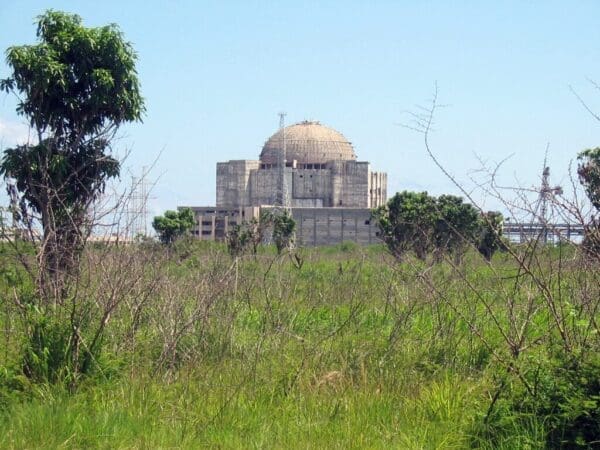
The unfinished Juraguá nuclear power plant near Cienfuegos, Cuba. Photo: David Grant / Wikimedia Commons, CC BY 2.0.
CUBA HISTORY · COLD WAR
Cuba almost had its own nuclear power plant
At Juraguá, near Cienfuegos, two Soviet-designed reactors were supposed to transform Cuba’s electricity system. More than $1.1 billion had already been spent when construction stopped.
Key takeaway
This was not merely a proposal on paper. Construction had begun, the first unit was far advanced in civil works, a town had been built for workers, and two VVER-440 reactors were planned. The collapse of the Soviet Union and Cuba’s economic crisis ultimately ended the project.
A few kilometres from Cienfuegos stands one of the most striking remnants of modern Cuban history: a nuclear power station that rose substantially from the ground but never produced a single kilowatt-hour.
Its name was the Juraguá Nuclear Power Plant. Conceived with the Soviet Union during the Cold War, it was meant to give Cuba a major new source of electricity and reduce dependence on imported oil. Thousands of workers were involved, and an entire community was developed to house some of the engineers, technicians, workers and their families.
Today, as power outages in Cuba remain a major concern, the story of Juraguá has renewed relevance. Cuba came remarkably close to entering the nuclear-electricity era.
Where is the Juraguá nuclear power plant?
The site is in Cienfuegos Province on Cuba’s southern coast, near Cienfuegos Bay and the locality of Juraguá. The plant was intended to connect to Cuba’s national electricity system and provide a substantial amount of power to the island.
| Item | Juraguá project |
|---|---|
| Location | Cienfuegos Province, southern Cuba |
| Reactors | 2 × VVER-440, V-318 model |
| Planned capacity | About 440 MW per unit |
| Construction began | 1983 for the first unit |
| Project ended | Suspended in 1992, abandoned in 2000 |
The project is sometimes described as a Soviet idea that never went beyond planning. That is incorrect: construction genuinely began, and a significant amount of civil work was completed.
Timeline: from nuclear ambition to abandonment
Cuba and the Soviet Union reach an agreement to build two nuclear units at Juraguá.
Construction begins on the first reactor.
The project expands; major infrastructure and Ciudad Nuclear develop around the plant.
The Soviet Union collapses, cutting Cuba off from its principal economic and technical partner.
Cuba suspends construction because viable financing is no longer available.
Cuba and Russia formally abandon the project.
Why did Cuba want the plant so badly?
For Cuba, nuclear power represented much more than an industrial project. The island depended heavily on imported petroleum and wanted to diversify electricity generation. Cooperation with Moscow also symbolized Cuba’s scientific and technological ambitions.
Generate a large share of electricity without burning additional imported petroleum.
The two planned units represented about 880 MW of nominal capacity.
Juraguá embodied technological and economic cooperation between Cuba and the USSR.
According to the World Nuclear Association, one reactor alone could have represented more than 15% of Cuba’s electricity demand at the time.

No, Juraguá was not “another Chernobyl”
| Feature | Juraguá | Chernobyl 4 |
|---|---|---|
| Reactor family | VVER-440 V-318 | RBMK-1000 |
| Principle | Pressurized-water reactor | Graphite-moderated reactor |
| Containment | Containment structure was planned | No comparable full containment around the accident reactor |
The Cuban V-318 design was derived from the V-213 and included a concrete containment structure with a metal liner. The Federation of American Scientists describes it as a more developed design than the earliest Soviet VVER units.
That does not mean Juraguá raised no safety concerns. U.S. assessments questioned aspects of design, construction quality, personnel training and the information available about risk. Those concerns should be distinguished from the simplistic claim that Juraguá would have been identical to Chernobyl.
Ciudad Nuclear: a town built around the project
Juraguá’s story extends beyond the reactor building. Nearby, Cuba created Ciudad Nuclear — literally “Nuclear City.”
The town was intended to embody Cuba’s scientific and industrial future. When work on the plant stopped, parts of the development remained unfinished. Ciudad Nuclear did not disappear, however; people still live there.
1991–1992: the Soviet collapse changes everything
The dissolution of the Soviet Union abruptly transformed the project. Cuba lost its principal economic partner, an important equipment supplier and much of the financial support needed to continue construction.
The country entered the Special Period, marked by severe shortages and a deep economic crisis. Completing a nuclear power plant became financially unrealistic.
By then, the first unit was far advanced in terms of civil construction, but the nuclear installation itself was still far from ready to generate electricity. The second reactor was considerably less advanced.
Why didn’t Cuba finish the plant later?
During the 1990s, Cuba and Russia explored several scenarios for reviving Juraguá. Completing it would have required hundreds of millions of additional dollars, modernization of some systems and foreign partners willing to participate.
European firms were discussed for certain control and safety systems, but no durable financing arrangement succeeded in restarting the project.
In 2000, Cuba and Russia finally abandoned Juraguá. Cuba’s nuclear-power project was officially over.
What remains of Juraguá today?
The huge concrete structure still stands near Cienfuegos. Its unfinished dome and industrial skeleton give the site an almost unreal appearance: infrastructure designed to operate for decades, frozen in the middle of construction.

The complex has become an unusual symbol of Cuban history: a remnant of the alliance with the USSR, a witness to the crisis of the 1990s and a reminder of the island’s once-enormous energy ambitions.
Would Juraguá have prevented Cuba’s current power crisis?
It is a tempting question, particularly in light of Cuba’s current electricity problems. But a simple “yes” would go beyond the evidence.
A major block of generating capacity and less dependence on some oil-fired thermal plants.
The need for nuclear fuel, maintenance, parts, modernization, qualified staff and a stable transmission grid.
If Juraguá had been completed, its equipment would now be roughly four decades old. It would itself have required substantial maintenance, investment and likely several rounds of modernization.
It is therefore impossible to state that Juraguá would have prevented today’s blackouts. What the project does show clearly is that Cuba’s energy dependence and search for alternatives to imported oil are not new problems.
A ghost plant, but a very real history
Juraguá is one of the places where world history and Cuban history intersect dramatically: the Cold War, Soviet power, Cuban technological ambitions, the collapse of the USSR and the economic crisis that followed.
Buildings were constructed. Engineers were trained. A town was developed. More than a billion dollars had been committed. Yet neither reactor ever produced electricity.
Continue exploring Cuba
What travellers should prepare for during electricity cuts.
History of Cuba
Key dates from 1492 to the present.
English Cuba guides
Practical travel information and current Cuba topics.
Quick facts
- 1976: Cuba–USSR agreement for the plant.
- 1983: construction begins on the first reactor.
- Two planned units: VVER-440 V-318, about 440 MW each.
- 1992: construction suspended.
- 2000: project formally abandoned.
- Today: the unfinished structures and Ciudad Nuclear remain near Cienfuegos.
Sources and photo credits
- World Nuclear Association — Emerging Nuclear Energy Countries
- American Nuclear Society — Cuban Agreement Awakens Memories of Juragua
- Federation of American Scientists — The Reactors at Juragua
- U.S. Government Accountability Office — Nuclear Safety: Concerns About the Nuclear Power Reactors in Cuba
- Photographs: Wikimedia Commons; licences and credits are shown under each image.
Historical estimates of cost, capacity and construction progress can vary slightly between sources.
📩 Abonnez-vous à notre Newsletter
Recevez directement nos dernières nouvelles, bons plans et astuces de voyage à Cuba 🌴